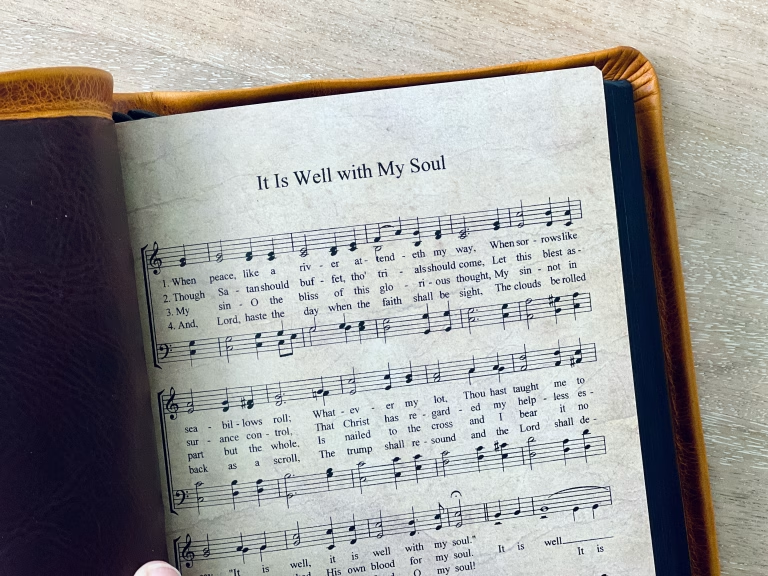


I live in a semi-detached house. Nobody warned me that some adjustments need to be made when you share a wall with another family. I’m not embarrassed to tell you that I like singing a lot, especially at home and especially when I’m happy. But I am a little embarrassed to tell you that sometimes I sing in different accents to mimic the artist whose song I’m singing along to. My wife has had to remind me that my neighbours are bound to hear me sometimes. Yet, singing is a very common expression of joy. According to Scripture, it always has been (maybe not the accents part).
It’s quite common in Scripture to find an author providing a grand description of God’s glorious works of grace and then pauses the flow of the narrative to burst into praise (see Romans 11:33-36 or 1 Timothy 1:15-17). Doctrine followed by doxology, you might call it. And that’s the point. Doctrine is not dry and dense as the word may seem to you, it is what fuels our praise. Doxology, or praise to God, can’t be divorced from doctrine because that is what inspires it. Let’s take a lesser-known biblical example as a case in point.
In Isaiah 12 we have songs of praise that come after God has revealed His plans for the future restoration of all things to the prophet. God had promised holistic peace when the whole earth “shall be full of the knowledge of the LORD as the waters cover the sea.” (11:9). In the last days, the Lord will set up the Messiah as a banner, and Jew and Gentile will both be brought together from the four corners of the earth to bring Him glory.
In chapter 12, the prophet Isaiah is told what he will say in response to God’s future blessings: “in that day you will say,” (the ‘you’ is singular). But then, in verse 4, the ‘you’ is plural, as the prophet tells the future congregation of the redeemed what they will sing. That’s a fascinating thing don’t you think? God has given us our hymn sheets in advance.
Here theology becomes doxology, as it always should. Knowledge of God demands praise of God.
But Isaiah 12 is not just early access to a yet-to-be-released song, like an upcoming sample track on Spotify. No, the lyrics of this inspired song act as a call for all of the redeemed throughout every generation to sing and tell of God’s great work of saving grace among all the nations. This is our present work too, and it’s a remarkable privilege.
The song of the future also includes the current mission of the Church. Four things are included in this mission:
1. Give thanks (v4a).
2. Proclaim His name (v4b). (Some translations have ‘call upon His name’, but ‘proclaim His name’ is probably the better translation. Or as Luther always translated this verse,“preach his name!”).
3. Make his deeds known to all people (v4c).
4. Remind everyone of His glorious name (v5). That last instruction is important because the word means make people remember that the LORD’s name is exalted.
We are to be thankful, daily witnesses in the world, always reminding people who God is and what He is like. One way we can fulfil all four of these Christian duties is as we sing.
The songwriter of The Wizard of Oz fame once said “Words make you think. Music makes you feel. A song makes you feel a thought.” This song of salvation engages our senses as we read and meditate upon it, but even more so when we sing it with our mouths and hear other saved-by-grace-sinners singing it in our ears.
One Bible commentator noted that here Isaiah foresees “a day yet to be when a restored people will, in hilarious celebration, delight in their only asset- the Holy One.” ‘Hilarious celebration’ doesn’t mean they’ve lost control of their senses and are giggling their way through the song; the old meaning of hilarious is ‘exceedingly joyous’. That’s exactly what impression we get from this little chapter in Isaiah, just look through it again one more time and count the joyful actions with me. ‘You will say’ (x2), ‘Give thanks’ (x2), ‘trust’, ‘joyfully draw water’, ‘call upon his name’, ‘make known his deeds’, ‘proclaim that his name is exalted’, ‘sing praises’, ‘make known in all the earth’, ‘shout, sing for joy’! I count 13 joyful actions that flow naturally as a response to God’s glorious grace.
Transformed hearts lead to transformed living. Joyful hearts produce joyful worship. How else would you respond to such grace but by singing praise to the One who is “my strength and my song, and [who] has become my salvation”? So the next time you meet with your brothers and sisters in Christ, let your praise be filled with joyful songs, as you celebrate the glorious things God has done. And let your singing be a sample of the future heavenly chorus that will sing the song of Isaiah together, as those who have “with joy… drawn water from the wells of salvation” (Isa. 12:3)!
Tell out, my soul, the greatness of the Lord!
Unnumbered blessings give my spirit voice;
tender to me the promise of his word –
in God my Saviour shall my heart rejoice.