

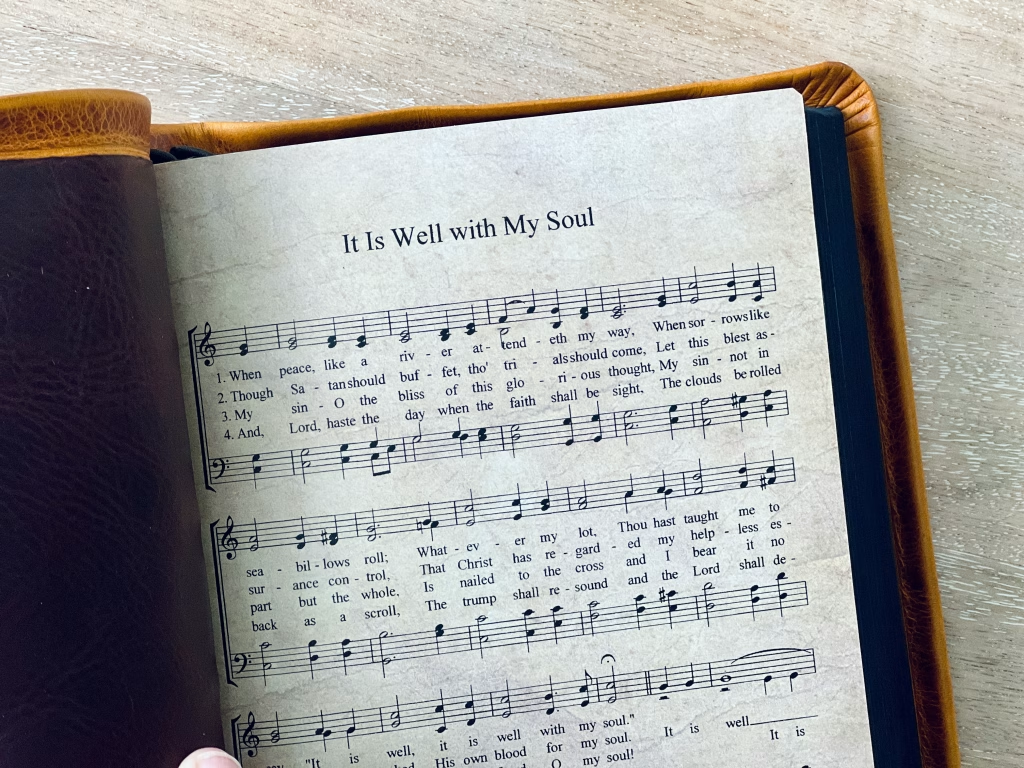
Sound doctrine is a non-negotiable. It’s required in our preaching, our discipleship, and our teaching. But do we apply the same care for doctrine to our singing?
Make no mistake, the faithful preaching of God’s Word is essential. Faithful sermons, preached by faithful men, rooted in Scripture and carefully applied, is one of the great gifts God gives his people week by week as the church meets together. But the pulpit isn’t the only place theology is being formed on a Sunday. The songs we listen to and sing have a way of sticking in our minds through pleasant sound, repetition and rhythm. A well-preached sermon can (unfortunately) be forgotten by Tuesday. But the line of a chorus from a song that’s sung week after week, year after year, becomes embedded and can surface in a moment of grief or doubt or joy decades later. What the church sings really does matter, and it requires the same prayerfully consideration given to everything else included in our worship.
Paul makes this clear in his letter to the Colossians:
“Let the word of Christ dwell in you richly, teaching and admonishing one another in all wisdom, singing psalms and hymns and spiritual songs, with thankfulness in your hearts to God.”
Colossians 3:16
Notice how Paul holds these things together. We are to let the word of Christ dwell richly, and we’re to sing. For Paul, singing isn’t the warm-up act before the real ministry begins. The song and the singing of God’s people is part of the ministry. It teaches. It admonishes. It carries the Word of Christ into people’s hearts in a way that lingers long after the service has ended.
Every song your church sings is, in some sense, an act of teaching and discipleship. And that means it deserves careful, prayerful attention.
Songs are always teaching – the question is what they are teaching
Maybe you’ve not thought of this before: Every song your congregation sings is making claims. About who God is. About who we are. About what Jesus has done. About what the Christian life really looks like. It’s planting phrases, poetic imagery, and some form of theology that will shape a congregation’s understanding of the faith over years – for better or for worse.
The question isn’t whether your songs are doing these things – they always are. The question is what work are they doing?
This isn’t meant to cause anxiousness, or a call to start stripping your song list down to a handful of pre-approved hymns. It’s a reminder and call to give faithful attention to what your congregation is consuming, like a shepherd gives to knowing what his flock is eating. Intentional, caring and prayerful attention.
With that in mind, here are four questions worth reflecting on as a music or leadership team as you look at the songs your church sings.
Question 1: Do these songs tell the truth about God and about us?
This is the most foundational question of all. What picture of God does this song portray to us? Is he presented as holy, sovereign, gracious, and personal? Or does he quietly shrink into nothing more than a feeling, a force, or simply an answer to our desires?
“God is spirit, and his worshipers must worship in the Spirit and in truth.”
John 4:24
While speaking to the Samaritan woman by the well, Jesus makes it clear that truth about God is not optional or an afterthought when it comes to worship. It is the solid foundation upon which everything else stands. Songs that are vague about who God is may produce real emotion in the moment, but over time they are revealed to be built on sand. A congregation that mostly sings about how God makes them feel, rather than who God actually is, will slowly drift toward a version of Christianity shaped more by personal experience than revealed truth from the Word.
This question also asks whether songs tell the truth about us. Healthy worship holds together the glory of God and the honest, desperate condition of the people standing before him. We were rebellious, guilty, and needy people. Enslaved to our own sin with no boast in ourselves, but who have received God’s gracious and merciful gift of salvation. When Isaiah encountered the presence of God, his immediate response wasn’t one of triumph, but instead it was an honest reflection of himself compared to a holy God: “Woe is me! For I am lost; for I am a man of unclean lips.” (Isaiah 6:5).
Songs that are relentlessly victorious, with no acknowledgment of our weakness, sin, or need for grace, can feed a shallow faith. The Psalms are not only full of joy and celebration, but equally of lament, confession, and desperate longing. A church’s repertoire that has no room for honest acknowledgement of our human condition is only telling half the story.
This doesn’t mean Sunday mornings need to feel heavy. It’s a wonderful opportunity to teach the entire gospel through the songs we sing.
Question 2: Is Christ glorified, and is the gospel present?
It’s worth asking the question: could this song be sung in a context that has nothing to do with Jesus? Could it pass for a motivational anthem, or for a love song to a special someone? If the answer is yes, that’s worth pausing over.
Revelation 5 is widely regarded as one of the most vivid pictures of worship in all of Scripture. A new song is sung to the Lamb who was slain, who ransomed people from every tribe and tongue and nation by his blood. The focal point of heaven’s worship is the Lamb who was slain, so it shouldn’t surprise us that Christ’s saving work ought to remain central in the songs of the church here and now.
“And they sang a new song, saying: ‘You are worthy to take the scroll and to open its seal, because you were slain, and with your blood you purchased for God persons from every tribe and language and people and nation’.”
Revelation 5:9
The gospel itself has a shape: through Christ’s death and resurrection we receive forgiveness, reconciliation with God, and eternal life, and are called to repent and believe the gospel. Many great songs of praise strive to carry that shape, even partially and service the church well. However songs that trade the language of truth and specificity of the gospel for generic and emotion-based lyrics, may feel something in the moment, but over time they train a congregation to think of worship as only a spiritual experience, rather than a response to the specific, glorious, costly grace of Jesus Christ.
Our songs should glorify Christ and remind us of the wondrous work he has done, not merely stir our emotions.
Question 3: Does this song build up the congregation, or just me?
In his letter to the Corinthians, Paul describes his desire and vision for corporate worship:
“When you come together, each of you has a hymn, or a word of instruction, a revelation, a tongue or interpretation. Everything must be done so that the church may be built up.”
1 Corinthians 14:26
The worship of the church isn’t a collection of private or individual devotional moments happening in the same room. It’s the body of Christ gathered together, encouraging one another, teaching one another, singing with one another.
So looking at our songs through this lens, are they actually singable by your congregation? Is it accessible to the person who is new to faith, or a veteran of the faith singing the same song for the 1000th time? Does it use words that people actually understand, or does it require a particular cultural or musical knowledge to engage with at all? Can the whole church body lift their voices in unity, or does it serve as a means for the musically gifted to perform and have an experience while everyone else watches on?
There will always be a place for undistracting beauty and musical excellence in worship. But a song that the congregation can’t truly sing is doing far less for the building up of the church than a simpler song they can sing from the heart. The goal isn’t to put on a performance. It’s participation of the whole body, together, declaring truth to God and to one another.
Question 4: Do you know where our songs come from?
This is a harder question, but an important one. Churches should certainly evaluate songs primarily on their lyrical content. Yet songs do not exist in isolation. They are often connected to ministries, conferences, and movements that shape how those songs are received and promoted. And it is worth knowing something about those sources.
In recent decades, a significant portion of contemporary worship music has come from ministries whose broader teaching and theology gives serious cause for concern. Some have drifted far from core Christian doctrine; in their understanding of Scripture, their approach to the prosperity gospel, their charismatic practices, or their view of the local church and its authority. The music produced by these ministries is often genuinely beautiful and emotionally powerful, and this is in part what makes it complicated.
The question isn’t simply whether a song passes your churches theological threshold. It’s also important to ask: what is our repeated use of this music or song communicating about our relationship to the artist or ministry behind it? Congregations often don’t distinguish between the song and its source. But over time, repeated use of music from a particular source can create an association, and even an openness, to that movement’s wider teaching.
This is not to say that every song from an imperfect source must be immediately discarded. Every tradition has its blind spots, and God has used flawed people throughout history. But it does mean being watchful and prayerful about what you are drawing from, and why. It means not allowing musical quality or cultural popularity to do the theological vetting for you.
What to do with what you find
If you work through these questions, you may find some gaps in your repertoire. Perhaps your song list is rich in celebration but thin on the lament. A congregation that never sings lament might slowly conclude that faithful Christians are always victorious, always confident, and never confused by suffering. Or perhaps there are songs that have been sung for years more out of habit than theological intention. Maybe whole areas of Christian truth such as judgement, and the return of Christ, are never sung about in your church.
The goal is not to clear the list overnight. Slow, prayerful consideration is needed here, especially when songs carry deep personal meaning for your congregation. Before you change anything, identify what’s missing as gaps in a song list are often more revealing than subtle errors.
If you’re a worship leader, encourage your pastor and elders to take part in this process. This is a collaborative act of shepherding the church, and so sharing the load with others in leadership will be a great benefit.
And above all, pray before you do any of it. The aim of this excercise is to build up a congregation whose affections are deeply and rightly stirred because they are singing truth. And when this truth is really grasped, it produces joyful, overflowing, and enduring praise.
Right doctrine doesn’t hinder worship, it fuels it. Let the word of God dwell richly in your church. Not only through what is preached, but through what is sung.