
One sphere of life that was radically transformed by the Reformers was corporate worship.1 The underlying principle that ignited this change was Soli Deo Gloria—Glory to God Alone. Martin Luther revised the liturgy for Mass to remove references to it being a sacrifice. Ulrich Zwingli ensured that relics, paintings, decorations, ornaments, and vestments were removed from church buildings. Martin Bucer is credited with introducing an early form of the regulative principle in arguing that corporate worship should be conducted according to Scripture, thus removing extra-biblical ceremonies and rituals. These actions, and others like them, reformed corporate worship in at least five ways.2
First, Scripture became central to corporate worship. This makes perfect sense given another of the Reformation slogans: Sola Scriptura. If Scripture is the final authority for the individual Christian, the logical step is to let it control corporate worship. In order to make Scripture central the Reformers ensured that corporate worship was conducted in the common language of the people to aid comprehension. Scripture was also read aloud in the common language, and preaching became expository as consecutive texts were both explained and applied book by book and week by week.
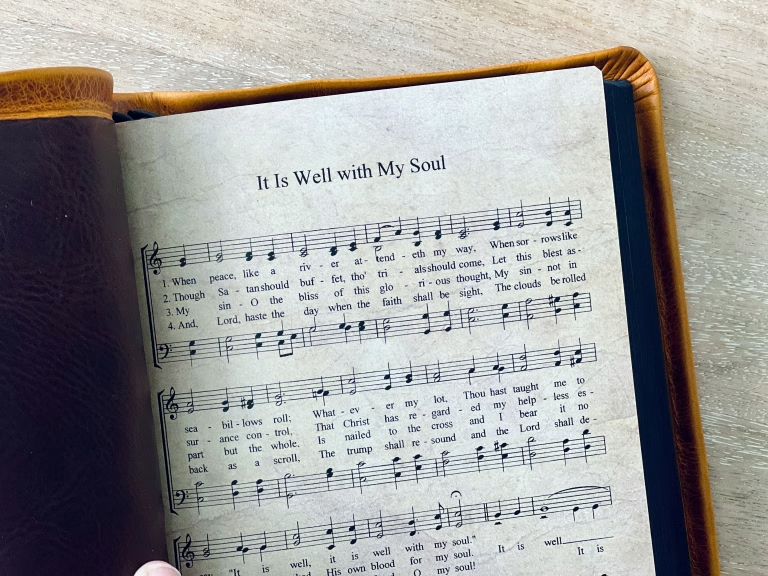
Second, the congregation participated in corporate worship. Undoubtedly, this was in part due to corporate worship being conducted in the common language of the people. Whether by intention or simply a corollary of the manner in which the Medieval Church conducted their services, the congregation was largely spectating. Driven by the Reformation cry of Soli Deo Gloria this changed under the influence of the Reformers. The noted historian Roland Bainton claims that Martin Luther should be considered the father of congregational singing.3 There was certainly a significant shift away from the performance of instrumental compositions to the congregation singing with one voice. In addition to congregational participation in song, the congregation was also invited to partake of both the bread and wine at communion. Previously they had been refused to participate of the wine.
Third, the sacraments were restored to their biblical simplicity. The Reformers argued: “If the sacraments are to edify they must be understood. In order to be understood they must be accompanied with biblical exposition and conducted with biblical simplicity.”4 As noted above Martin Luther made this move by revising the existing liturgy for Mass. Furthermore, the Reformers removed five of the Medieval Church’s seven sacraments, leaving only baptism and communion.
Fourth, there was a renewed appreciation of and focus on the work of the Holy Spirit. In the Medieval Church the external features of corporate worship had assumed priority. The Reformers desired to direct attention away from the external towards the internal, and in particular the work of the Spirit in the Christian. One practical way in which this was accomplished was by punctuating the corporate worship service with prayer. By punctuating the service with prayer, the Reformers subtly communicated and demonstrated utter dependence on the Holy Spirit’s work in the life of the congregation.
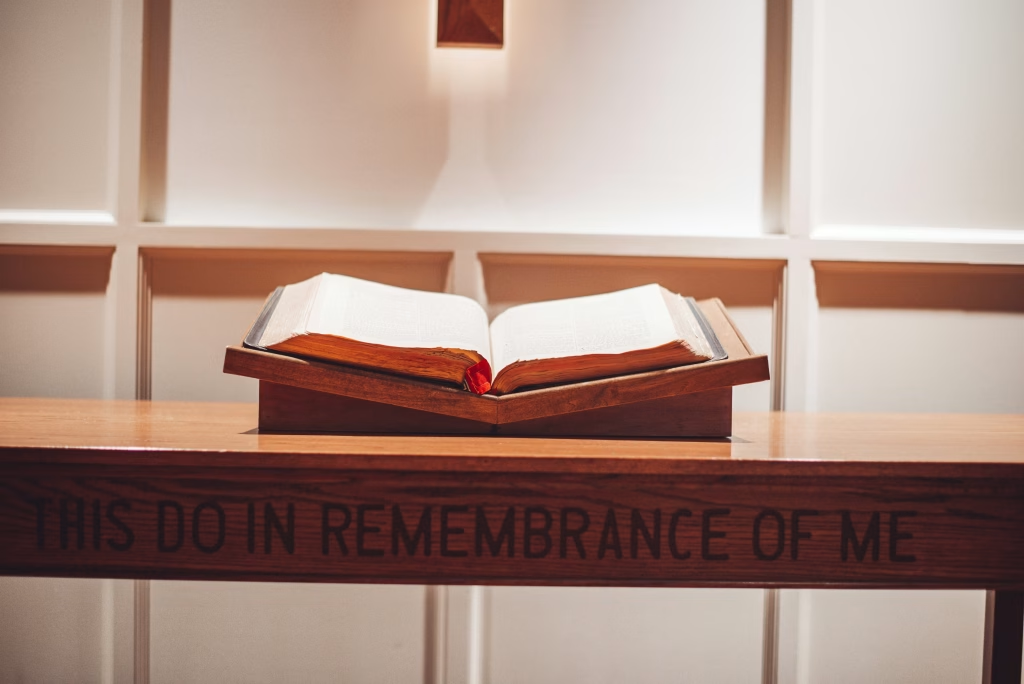
Fifth, church architecture was altered. For the Reformers and their first converts the most notably change was the replacing of the altar with a table. Communion was no longer served from an altar, as a sacrifice would be, but from a table, as a meal would be. The Reformers also moved the pulpit to take centre stage, thus communicating the centrality of Scripture in the life of the congregation. Indeed, church buildings as a whole became less ostentatious. Although it took time, eventually church buildings became much simpler (a particular feature of my tradition, Baptists).
The Reformation cry of Soli Deo Gloria clearly reformed the sphere of corporate worship. Yet, it is significant that it not only altered the theory, but the practice. If God alone was to be given all the glory, one did not just need to think differently, but also act differently. The contemporary church should review our practice of corporate worship for it may reveal a theology different from what we purport to hold to. If Scripture is not central, the congregation active participants, the sacraments simple, the Spirit sought in prayer and the building orientated to the word, and particularly the word preached, we have perhaps strayed from our Reformation roots.
1 This post is a lightly adapted portion from Davy’s book, Five: The Solas of the Reformation, Tulip Publishing, 2020, pp. 74–76. To discover more about the Reformation and its influence on us today pick up a copy: https://tulippublishing.com.au/book/five-the-solas-of-the-reformation/?v=7885444af42e.
2 For an expansion on the following five aspects of corporate worship see Terry L. Johnson, The Case for Traditional Protestantism: The Solas of the Reformation, Banner of Truth, 2013, pp. 126–43.
3 Roland Bainton, Here I Stand: A Life of Martin Luther, Hendrickson, 2009, p. 344.
4 Johnson, Traditional Protestantism, p. 129.