


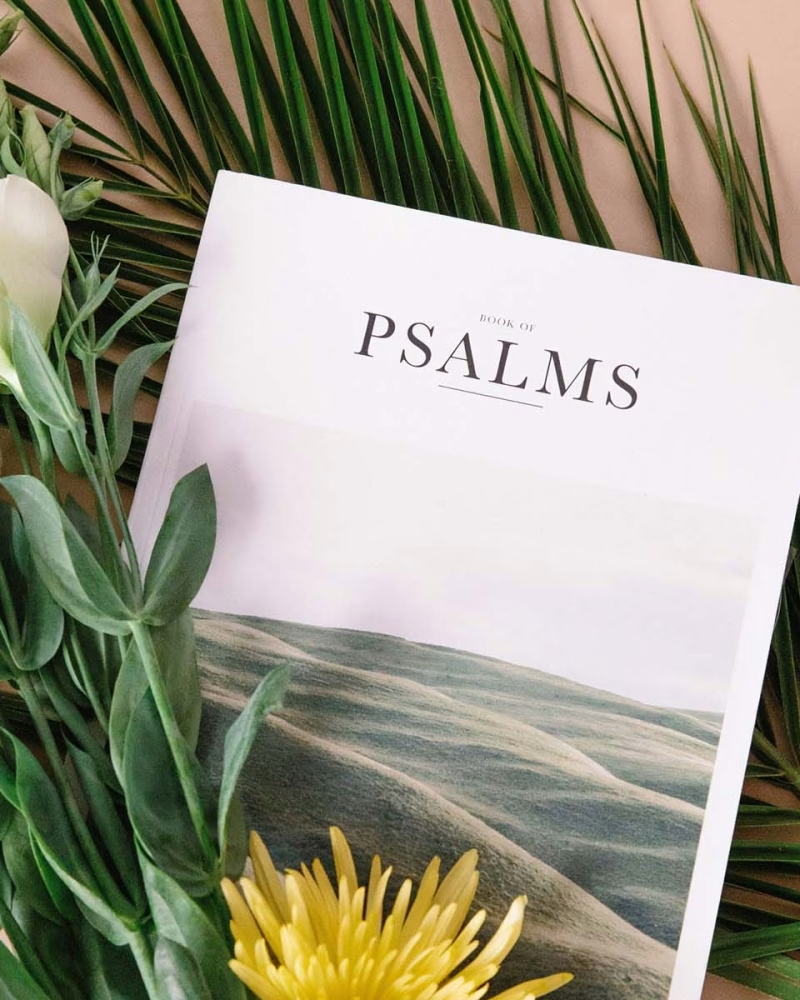
When was the last time your church sang a Psalm? Not a song loosely inspired by one, but the actual words of Scripture, sung as the church’s repeating the Word of God in praise back to the Lord?
If the answer is recently, then sadly, recorded worldwide trends show your church to be in the minority. A clear pattern emerges of the same small handful of names again and again: a few culturally popular, heavily marketed worship brands, some tied to ministries whose wider theology and practices should give a discerning church real pause.
Here and there a song draws on a Psalm’s imagery or echoes its language, and there are faithful songwriters and hymn-writers doing careful, direct work with the Psalms today. But among the songs most widely sung across the global church (particularly in the west), those direct settings remain the exception rather than the rule, and the Psalms themselves rarely make it into the congregation’s mouth in their own words.
That’s not simply a matter of taste. When we compare today’s most-sung songs against the church’s older hymns, there’s a clear drift towards individualism. Not simply in the use of personal language; the Psalmists don’t shy away from looking inward or personal language such as “I” and “me” too:“Why are you cast down, O my soul, and why are you in turmoil within me?” (Psalm 42:11). But rarely will the psalm stop at naming a feeling. The Psalmist preaches in response to the state of his own soul with what is known to be true about the Lord. His personal wrestling doesn’t stay internal for long.
“I will declare your name to my brothers; in the midst of the congregation I will praise you”
Psalm 22:22
In much of what is sung today, that same personal language increasingly serves private feeling over shared truth, and truths about who God is gives way to feelings in the moment, with no turn towards the congregation we’re a part of.
The Psalms contain both personal and corporate praise and lament, honest reflection, and a wide emotional and theological range. Yet sadly they are being left on the shelf collecting dust in favour of songs chosen more for how well they perform and make you feel, than for what they teach and form in a congregation.
For most of church history, this would have been unthinkable. The Psalms were the church’s first hymnbook, sung by God’s people long before a single “modern” worship song, or worship brand, ever existed.
So let’s ask ourselves: why has the oldest form of Christian song become the one most churches no longer sing, pushed aside by newer, diluted, more self-focused songs? And what is the church losing by letting it go silent?
Here are four reasons why the church should still sing the psalms:
Because they are the words God has given us to sing
Every other song your church sings, however faithful, is a human composition. It has been written by a gifted believer, weighed against Scripture, and hopefully has been found to be sound. But the Psalms are different in kind, not just in age. They are inspired Scripture, given by God himself to be sung by his people.
“Let the word of Christ dwell in you richly, teaching and admonishing one another in all wisdom, singing psalms and hymns and spiritual songs, with thankfulness in your hearts to God.”
Colossians 3:16
Notice that Paul doesn’t set Psalms against hymns and spiritual songs as though they were rivals. He names them together as the shared repertoire of the church’s song. But of the three, only the Psalms come to us pre-written by the Holy Spirit. When we sing them, we’re not offering God our best attempt at words about him. We’re singing back to him the very words he chose to give us.
This doesn’t make every other song worthless; but it does mean a church that never sings the Psalms is leaving its most reliable hymnbook unopened.
Because they teach us to feel what we don’t yet feel
Most contemporary worship music is written from a narrow emotional register: gratitude, triumph, longing for God’s presence, quiet devotion. These are good and biblical postures, but read through the Psalms and you’ll find a far wider range of the human heart laid bare before God: grief, confusion, anger at injustice, confession of sin, and even the raw honesty of feeling forgotten by him altogether.
“How long, O Lord? Will you forget me forever? How long will you hide your face from me?”
Psalm 13:1
“O Lord God of hosts, how long will you be angry with your people’s prayers? You have fed them with the bread of tears and given them tears to drink in full measure.”
Psalm 80:4-5
A congregation that only ever sings of victory and joy will, over time, come to believe that doubt, sorrow, and lament have no place in the Christian life. But the Psalms teach us the opposite. They give the grieving believer words to sing when their own words have run out, and they give the rejoicing believer words to sing on behalf of a brother or sister who is, this very week, being fed on nothing but the bread of tears.
“Is anyone among you suffering? Let him pray. Is anyone cheerful? Let him sing praise.”
James 5:13
The Psalms don’t wait for us to feel a certain way before we’re allowed to sing them. They shape what we feel by putting true words in our mouths first.
Because Jesus himself sang them
It’s worth remembering that the Psalter wasn’t only the people of Israel’s songbook. It was also the songbook of Jesus.
He was raised on the Psalms, prayed them, quoted them, and on the night before his crucifixion, sang them with his disciples.
“And when they had sung a hymn, they went out to the Mount of Olives.”
Matthew 26:30
And when the weight of that cross finally came upon him, it was a psalm that formed his final cry:
“And about the ninth hour Jesus cried out with a loud voice, saying, ‘Eli, Eli, lema sabachthani?’ that is, ‘My God, my God, why have you forsaken me?’”
Matthew 27:46 (quoting Psalm 22:1)
When we sing the Psalms, we are not merely singing ancient Hebrew poetry. We are singing the same words our Saviour sang, prayed, and cried from the cross. There is an encouragement in knowing our Lord learnt and sang these very same words before us, and sings them with his people still.
Because the church has always sung them
From the earliest centuries, through the Reformation, and into our own hymnals, the Psalms have been the one constant in the church’s song.
Each generation of the church has taken up that call in its own way, yet to let the Psalms fall silent in our own generation is to break with nearly every generation that has gone before us. It would be a strange and backwards kind of progress that leaves behind the one songbook every previous era of the church agreed was worth singing.
Recovering what we’ve forgotten
None of this means abandoning contemporary songs, or treating every modern chorus with suspicion. Many of them serve the church well, and God has always given his people gifted writers to compose a new song to the next generation.
“Oh sing to the Lord a new song; sing to the Lord, all the earth! Sing to the Lord, bless his name; tell of his salvation from day to day. Declare his glory among the nations, his marvellous works among all the peoples!”
Psalm 96:1-3
But a church that sings only what was written this decade has cut itself off from a depth and range of praise, lament, and confession that no amount of new songwriting can ever fully replace.
If your church hasn’t sung a psalm in years, that’s worth noticing. It’s worth changing. It might be as simple as choosing a modern setting of Psalm 23 or Psalm 46 for a season. It doesn’t need to happen overnight. But it should happen.
Because long after the songs we’re singing today have been forgotten, the Psalms will still be there, inspired, enduring, and given by God for exactly this purpose: to put his own words on his people’s lips.
“I will exalt you, my God the King;
I will praise your name for ever and ever.
Every day I will praise you, and extol your name for ever and ever.
Great is the Lord and most worthy of praise;
his greatness no one can fathom.
One generation commends your works to another;
they tell of your mighty acts.
They speak of the glorious splendour of your majesty—
and I will meditate on your wonderful works.
They tell of the power of your awesome works—
and I will proclaim your great deeds.
They celebrate your abundant goodness and joyfully sing of your righteousness.”
Psalm 145:1-7